
Getting Started
Optimize HRAs
Lead Generation
Nurture Journeys
Data & Integrations
Unlock HRA Documentation
Medicom HRA Documentation
HRA Organic Promotion Best Practices
This guide outlines how to promote your Health Risk Assessments (HRAs) through organic, evergreen tactics that build long-term visibility, engagement, and trust — without relying solely on paid campaigns.
The key to effective HRA promotion is using every available channel, both paid and organic. Paid campaigns drive immediate volume, while organic channels sustain engagement and build awareness over time.
Your existing site visitors are already exploring your website and are well positioned to engage with tools like HRAs as part of their patient journey. Ensuring your HRAs are visible across relevant web pages, organic social channels, and offline touchpoints creates a consistent, omni-channel experience that grows completions over time.
We’ve seen that consistent organic visibility doesn’t just drive completions—it deepens patient trust by providing education and early action opportunities that demonstrate your organization’s commitment to health and prevention.
Organic promotion works best alongside paid efforts:
- Paid channels drive high-intent traffic and quick completions.
- Organic channels sustain engagement, capture inbound search interest, build trust, and support SEO and brand recall.
💡 If you haven’t already, check out our companion article: HRA paid promotion best practices to learn how to maximize your paid campaigns alongside organic efforts.
Website Integration Best Practices
A dedicated hub page acts as a central destination for all assessments, improving navigation, SEO, and discoverability.
Recommended setup
- Include every active HRA on one page.
- Add a short intro paragraph such as:
“Take one of our free Health Risk Assessments to learn more about your health and discover care options available to you.” - Organize HRAs by category or service line (for example, Heart & Vascular, Cancer Care, Orthopedics, Weight Management).
- Use visual tiles or buttons with icons or brief descriptions for each assessment.
⚠️ Tip: Link to your hub page in your main navigation under “Health Tools” or “Patient Resources.”
2. Highlight HRAs on the home page
Surface HRAs prominently on your homepage to increase visibility and access.
Ideas
- Add a “Check Your Health” or “Free Risk Assessments” section.
- Feature two to three top-performing HRAs such as Heart Health, Weight Loss, or Cancer Risk.
- Rotate featured HRAs by awareness month (for example, Heart in February, Breast Cancer in October, Diabetes in November).
- Include a link to your HRA hub page for deeper exploration.
⚠️ Tip: Clients who maintain a Health Risk Assessment section on their home page consistently see higher monthly completion rates and improved engagement sitewide.
3. Embed HRAs across service line pages
HRAs should appear throughout the site — not just on a single hub page — so they reach users who are already exploring related services.
Examples
- Add the Heart HRA to Cardiology or Heart Care pages.
- Include the Knee & Hip HRA on Orthopedics pages.
- Link the Weight Loss HRA within Bariatrics or Nutrition content.
⚠️ Tip: Use a consistent CTA phrase such as: “Not sure where to start? Take our quick [Service Line] Health Risk Assessment.”
💡 Learn more about embedding HRAs using the Embed Code Script
4. Leverage podcasts, video, and employee engagement channels
Don’t overlook emerging organic channels like podcasts or internal communication platforms for promotion. These channels can extend reach and strengthen trust across audiences.
- Podcasts: Mention HRAs in relevant podcast episodes or audio segments, linking to the HRA hub in show notes.
- Video: Integrate short “Check your health” callouts or feature HRAs in video content on your site or social channels.
- Employee Engagement: Many clients create internal HRA links (e.g., Heart HRA – Internal) to encourage participation among employees.
- This allows separate tracking and reporting for internal engagement.
- During awareness months, clients have tied these campaigns to giveaways or raffles (e.g., an Apple Watch, spa day, or fitness tracker) to encourage participation and build a culture of health.
⚠️ Tip: Employee and community engagement campaigns not only build participation but also deepen trust — reinforcing your organization’s role as a credible health partner.
Content and SEO Best Practices
1. Optimize for search
Each HRA landing page supports your organic SEO strategy.
Best practices
- Use meta titles and descriptions that match the HRA topic (for example, “Free Heart Health Risk Assessment | [Your Brand]”).
- Include common search terms such as “am I at risk for [condition],” “free health quiz,” or “online health check.”
- Add an FAQ section on the hub page to improve organic search performance.
2. Leverage blog and content marketing
Promote HRAs within educational content and resource articles.
Ideas
- Add “Take the HRA” CTAs at the end of relevant blog posts.
- Feature HRAs in seasonal or awareness-month articles (for example, “5 Ways to Protect Your Heart Health” → Heart HRA).
- Repurpose high-traffic blog posts by adding links to related assessments.
⚠️ Tip: On blog pages, use the Embed Code Script so UTM tracking flows from the parent article to the HRA completion.
💡Read our Embed Code Script guide
2. Use email newsletters, nurture campaigns and organic social posts
Email and social are some of the most effective organic channels for sustained engagement.
Ideas
- Add a “Health Assessment of the Month” feature in newsletters.
- Spotlight HRAs across multiple service lines (Heart, Weight Loss, Cancer, Ortho).
- Include HRAs in nurture series designed to re-engage past participants or move high-risk leads toward scheduling.
- Use curiosity-driven subject lines and short, friendly body copy (for example, “Have you checked your heart health lately?”).
⚠️ Tip: Add tracking links (UTMs) to measure completions from organic email and social channels.
Campaign and Awareness Month Planning
Align HRAs with awareness months to keep content fresh and timely.
| Month | Focus Area | Recommended HRA |
| January | New Year, New You | Weight Loss HRA, Healthy Weight, Heart HRA |
| February | Heart Health Month | Heart HRA |
| March | Colorectal Cancer Awareness Month | Colon Cancer HRA |
| March | Sleep Awareness Month | Sleep HRA |
| May | Mental Health Awareness Month | Depression HRA, Anxiety HRA |
| May | Stroke Awareness Month | Stroke HRA |
| June | Men's Health Month | Prostate Cancer HRA |
| September | Suicide Prevention Month | Depression HRA, Anxiety HRA |
| September | Healthy Aging Month | Heart HRA, Stroke HRA, Sleep HRA |
| October | Breast Cancer Awareness Month | Breast Cancer HRA |
| October | National Substance Use Prevention Month | Substance Use HRA |
| November | Diabetes Awareness Month | Diabetes HRA, Weight Loss HRA |
| November | Lung Cancer Awareness Month | Lung Cancer HRA |
| November | COPD Awareness Month | COPD HRA |
| December | Healthy Weight Awareness Month | Healthy Weight HRA, Weight Loss HRA |
⚠️ Tip: Update homepage banners, hub tiles, blog and social content for awareness months to feature relevant HRAs.
Maximizing Reach with QR Codes
QR codes are an easy, low-effort way to connect offline audiences to your digital HRAs.
Ideas for QR code placement
- Flyers, direct mailers, and brochures
- TV displays in waiting rooms
- Signage in offices, hospitals, and community events
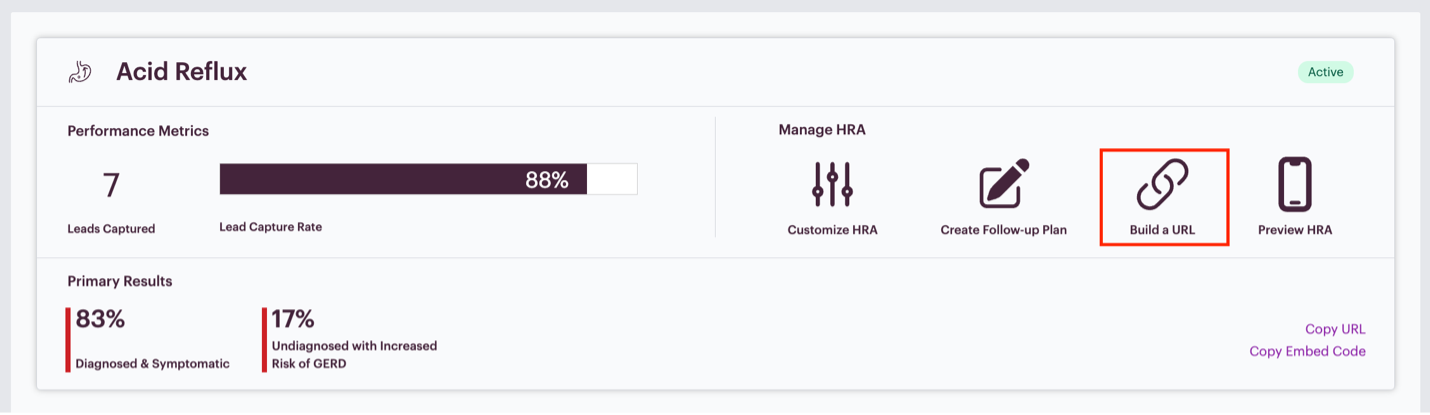
⚠️ Tip: Generate QR codes using the Build a URL tool to apply UTM parameters (for example, utm_source=qr-code&utm_medium=hospital-waiting-room) so performance can be tracked across different placements. Download the PNG version of each QR code to add to creative assets.
Key Takeaways
- The most successful HRA programs use an omni-channel approach across paid, organic, and offline channels.
- Organic visibility ensures HRAs stay discoverable year-round.
- A dedicated hub page and homepage placement drive the highest ongoing completions.
- Embedding HRAs across service-line pages captures users when intent is strongest.
- QR codes extend reach to offline audiences and enable performance tracking.
- Layer HRAs into newsletters, nurture emails, organic social, podcasts, and internal employee campaigns for deeper engagement.
- Align HRA promotion with seasonal awareness campaigns to maximize reach and engagement.
💡For more advanced tactics, see our companion guide: HRA paid promotion best practices
Need help?
Our team can help you:
- Optimize your organic HRA promotion strategy with your unique setup
- Provide best practices for HRA hub pages or homepage feature sections
- Add QR codes and UTM tracking for attribution
- Embed HRAs across your site using the embed code scripts
- Develop organic nurture campaigns or internal engagement initiatives